
My final post in this series on El Cerrito’s fiscal governance history is about everyone’s favorite topic, pension liabilities. After this, I’m going to spend some time looking towards the future, because honestly I’m a little tired of the past decade and I’d like to think about something more aspirational for a minute. But I think the pension liability story is one that deserves some dedicated time, because it’s an esoteric topic that I think many people (myself included) struggle to understand and find alarming. Buckle up; it’s gonna be another long one.
I want to start by talking about the scary acronym, UAL—Unfunded Accrued Liability, or sometimes Unfunded Actuarial Liability—which isn’t actually any less scary once it’s spelled out. Part of what makes it scary is the large number that gets attached to it when we talk about what’s going on in El Cerrito. El Cerrito’s UAL is approaching the territory of $90 million ($87.5M as of June 30, 2024, the latest available reports I see). That sounds like a huuuge amount in the context of a city whose total expenditures for FY2026 are also around $87 million. It prompts a lot of questions: Is that how much pension debt we owe? Is it accruing interest? Are we going to go bankrupt trying to pay pensions?
Well, I can’t speak with the confident authority of someone with a finance background, but I’ve been asking a lot of questions lately to try to understand what our pension liability is, how we’re addressing it, and how much real risk it represents to us as a community. Here’s my best stab at putting it into plain language. Bear with me, this isn’t super straightforward so I may seem to be meandering a bit. (If long form explainers aren’t your thing, I recommend at least watching the very brief (just over 2 minutes) pension portion of this budget presentation given by El Cerrito’s own Financial Services Manager Claire Coleman this past spring. If you’re a big finance nerd, you can even check out the official CalPERS documentation including each city’s actuarial reports and annual pension plan costs—although at that point, what are you even doing here?)
First of all, just to set the stage: For whatever reason, public employers are one of the last bastions of pension retirement systems in this country. Outside the public sector, pensions have largely fallen out of use (perhaps practically, because they are tricky to fund, or because people change jobs more often these days). Most private companies have switched retirement benefits (if they’re provided at all) to personal accounts like 401(k)s that place the onus of determining savings and investment strategy onto the individual.
There are two questions here that sometimes get conflated: 1) Are pensions a good idea? And 2) How do we pay for them? I have no comment on the first question at this time; that’s a topic far above my pay grade. But if we have to take pensions as a given, then the latter question is the practical concern that this post will try to address.
Like all California cities (and school districts and all sorts of other public agencies), El Cerrito is currently paying pensions to former employees and promising future pension payments to its current employees. These pension payments are administered by CalPERS (California Public Employees’ Retirement System), which takes advanced payments from California cities and employee salaries and puts them into an investment portfolio. Those payments are based on how much CalPERS anticipates cities will owe their employees after they retire, until they die: a number nobody can actually know until after the fact. Add to that, the investment portfolio itself also adds uncertainty, because markets aren’t perfectly predictable. So every year, cities pay for future pensions obligations based on complex and highly regulated formulae which some might call a best guess—an actuarial estimate—of how much CalPERS thinks they’ll need in the future. This is similar conceptually to how personal retirement calculators work, only scaled to massive population size and based on substantially more complex math.
Now, the problem is that nobody has a crystal ball, so sometimes the actuaries overestimate, and other times they underestimate. In the early 2000s, public employers in California ended up with a sizeable gap between their total anticipated obligation and the amount in their pension funds, a gap particularly attributable to the 2008 financial crisis, compounding on a trend of increases in pension plans across the decade prior. If you’re curious about the history, I recommend this highly detailed blog by journalist Ed Mendel, shared with me by Claire Coleman1. I particularly liked this entry which summarizes quite a lot of events that built the pension crisis from the 1980s onward.
I recently talked at length with FAB member Mike McDougall about the nature of El Cerrito’s pension liability. First, some terminology: If pension liability is the total amount that we have promised our employees (for life),2 the gap between what CalPERS has in our fund and what we owe is the unfunded part of that liability, or UAL. Mike likened pension liability to a reservoir, where the amount in the investment account is the volume of water in the reservoir, with water coming in and going out all the time. He pointed out that it’s not actually unusual or even necessarily all that alarming to not have a completely full reservoir at times, so long as we don’t end up on a trajectory where the reservoir ends up excessively drained and stressed (similar to thinking about drought risk—the analogy seems to hold up pretty well).
When it comes to thinking about unfunded liabilities, I find the funded ratio to be a more useful figure than the actual raw dollar amount of our UAL. You can see in the figure below how the overall picture of California pension plans was substantially impacted by the 2008 crisis. El Cerrito’s funded ratio was 71% as of June 30, 2025, so somewhat lower than the CalPERS average today, probably linked to the city’s recent financial crisis and our status as a full-service city with police and fire.

A little more on the UAL. It’s a number calculated annually by CalPERS that expresses, again, the difference between the total amount El Cerrito has promised as of this year and how much we currently have covered by the fund. Importantly: it’s still an estimate! Because we don’t know exactly how much we will have owed a retiree (until they die), and we don’t know when any individual will die ahead of time. And, simultaneously, we still can’t perfectly predict what markets will do, i.e. the amount of interest our investment fund will return year-to-year. So CalPERS gives us a number that they calculate based on actuarial black magic3 and their expected long-term rate of market returns (6.8% is the current figure), and uses that calculation to set additional UAL payment requirements to cover the current gap on top of our normal forward-looking pension contribution.
The idea with the UAL is to adjust our payment plans every year with the best actuarial evidence of our future liability. So every year, we get a new payment schedule that runs for 20 years (meaning we are paying the sum of 20 stacked payment plans at any given time). That means we could end up with a higher payment plan for next year if the investment fund does poorly (leading to increased UAL that year)… but that only affects one out of twenty current payments, and then the UAL could go back down the following year. This is the really esoteric part. I have heard it compared to a metaphor of having twenty overlapping mortgages at any given time, but it’s not quite like my experience of a mortgage because we don’t know exactly how much we will end up owing in the future—only the sum of past payment plans–and while as a metaphor it provides a helpful portrait of the layering, it doesn’t fully illustrate all of the mechanics involved.
I find it helpful to crunch some fake numbers for illustration. (Take it or leave it, it’s not really essential to the story.) In this example, the UAL (and its associated payment) pops up in 2017 and rises for a few years, perhaps like what might happen in a lengthy economic downturn.

Anyway. This is extremely complicated stuff. I haven’t even mentioned some factors like the grace period CalPERS provides to give cities time to make adjustments in their budgets in case of a market crash. I’ve been avoiding using the term “amortization.” To be honest, I don’t think it’s all that important for ordinary folks to wrap their heads around twenty backwards-facing best-guess mortgage-like-things running staggered in parallel. That’s what we pay experts for. What matters is that we—like all California cities—have a running payment plan that is continually taking 20 years of past historical financial shenanigans into account, and that we can project—albeit imperfectly—how much we expect to be paying in the years ahead.
(A side note: Our team can’t easily put meaningful error bars on that projection, because we don’t have all the numbers CalPERS uses to calculate the UAL in the first place. CalPERS does provide a range of scenarios and assessments based on different rates of return and fund maturity… but even if we do have a robust portrait of uncertainty, it’s not clear to me how that portrait should affect our decision-making. Would seeing wide error bars lead us to be more conservative? I don’t know.)
Okay. Now, a SUPER CRITICAL part of all of this is a key historical event that shapes our overall pension liability portrait in the upcoming years. Starting in 2013, a pension reform law called the California Public Employees’ Pension Reform Act (PEPRA) caused a notable reduction in the size of pensions being granted to public employees going forward. PEPRA reduced benefits for employees hired after 2013, but it did not erase benefits already earned by earlier employees. As a result, El Cerrito can hire workers under less-expensive formulas while still paying large amounts for older benefit tiers. This is why pension reform can improve the long-term trajectory without producing immediate budget relief.
Today, 60% of current El Cerrito staff have post-PEPRA pension plans. Over the years ahead, we know that a lot of retirees on the more expensive classic plans are going to, as one delicately says, “age out” of the system. And that’s accounted for in the overall pension payment projection we’re making. (Thank you, actuaries.) We can assume, all else being reasonably stable, that we’re coming up to the peak in our UAL pension payments around 2032, and the demographic shift that PEPRA created will enable us to gradually “catch up” on our funded liability. But in the meantime, we’re paying quite a lot year-to-year on both the baseline pension payments plus the back-payment portion associated with each years’ UAL. Knowing what we’re already signed up to pay for the next t-minus 20 years means we expect payments to peak at around $14 million around 2032. Which is certainly a sizeable chunk of our operating budget.
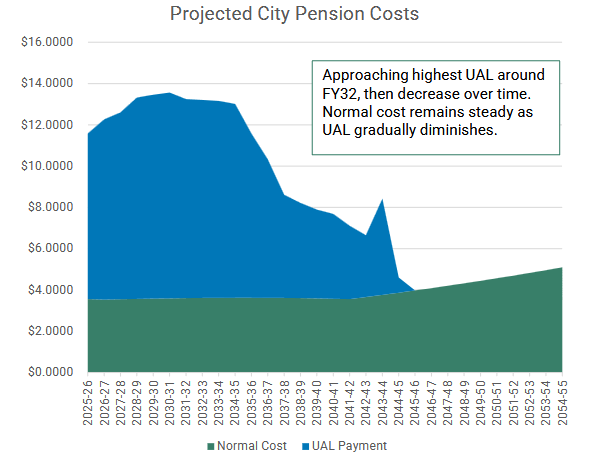
Importantly, what the UAL doesn’t tell us: 1) What we have the power to change in the future due to our choices in staffing, union contract negotiations, adjustments to salaries, etc; and 2) How much external uncertainty there is (we can’t predict what will shape market forces; there may well be any number of bad years ahead). We expect the UAL to change every year but not necessarily to neatly follow the projected curve. Perhaps some years it will not even drop at all or may even rise considerably. The question I care about is, how much risk are we comfortable taking on, proceeding with projections that don’t try to account for uncertainty? And what amount of unfunded pension liability may be tolerable to us—or, put another way, how quickly should we target getting to a “big enough” pile of money in our investment fund, given what we expect to owe in the future? Any money put into the fund is unavailable for us to use in other ways; conversely, UAL payments represent a missed opportunity to make a return.
I sometimes hear people grumble when they talk about the Section 115 trust, citing it as an inadequate answer to the size of our liability. Background on the Section 115: a few years ago, the city managed to scrape together $1.5M to put into an investment fund designated solely to help with our pension payments. We also created a budgetary surplus policy to ensure a portion of any money left over after fully funding our reserves will go into the trust as well. The trust has since been funded to $3M, which is nice, but we haven’t had much in the way of surpluses lately, so that’s probably about all we get for now. The purpose of the Section 115 is not to save up to $90M. We’re already making those big annual payments on our 20 “mortgages” that should (again, mostly driven by PEPRA) lead to the UAL coming down over time.
If we wanted to drive the UAL down faster, we could make Advanced Discretionary Payments (ADP) on top of our CalPERS mandated payment, but that extra money would then be subject to higher risk than might be desirable for addressing a near-term target, and goes out of our control. (Think as an analogy of the investment strategy on a 401(k); the conventional wisdom is to shift from high risk investments when you’re younger to more stable portfolios closer to retirement, so you don’t risk getting wiped out right when you need the money.) By putting the money into a Section 115 trust, the city can choose the risk level of that investment, as well as when to use it for best effect. The $3M in the Section 115 is intended to help us get through the coming peak years with less pain—to take the edge off the ~$14M projected payment in 2032, for instance. The Finance team refers to this as “smoothing out” our payments. So (for example) if we end up owing CalPERS $12.5M in 2029, we could choose to use $0.5M from the trust to un-squeeze the general fund by that amount, then use another $0.5M in 2030, then $1M in 2031 and another $1M in 2032. (Or something like that; I’m sure there would be a more complicated way to make all the numbers look the prettiest.)
I mentioned overly optimistic CalPERS investment forecasts as one piece of the origin story of our unfunded liability. The other element is that El Cerrito accrued outsized unfunded liabilities as a factor of maintaining high staff and salary levels–especially attributable to being a full-service city with large public safety departments. That’s worth consideration in future discussions, for sure. Seeking to understand how we got here is certainly important, but the essential thing to me is not identifying all the exacting past details of how our reservoir got to this level, but determining whether we are continuing to pay out more than we are putting in, and whether the volume is low enough to put us at risk of not being able to pay our bills. If I look back across the past few years, the funded ratio—the volume of water in the reservoir—is rising, slowly but surely. And this is happening in our neighboring cities, too; it’s part of a trend caused by both more conservative CalPERS projections and payment requirements since the financial crisis, plus the big impact of PEPRA.
It’s great that we are expecting things to get better as the pre-PEPRA accounts dwindle over the next decade, but we may not want to rely entirely on that mechanism, if we have the capacity to reduce the UAL faster. Paying a large fraction of our pension costs out of pocket is the equivalent to holding lots of money in a savings account where it cannot accrue meaningful interest—maybe not the end of the world, but certainly not the savviest way to manage our funds. When we have the ability to do so, we can get a discount rate on the UAL payment by “pre-paying” what we owe at the beginning of the fiscal year. Even in a post-PEPRA world, we may want to continue funding the Section 115 trust during surplus years in order to have the means to offset downturns—or changes to pension laws4—in the future.
Anyway! I’ve spent nearly 3000 words on what is an almost alienating topic, and I can’t… I just… I can’t get upset about it all. Yes, I think it’s valid to feel reasonably concerned that we’re not saving enough, given overall political uncertainty, tariffs and inflation, and the risk of economic bubbles bursting. I think many of us are feeling economic anxiety, looking at the actions of our federal government these days. And it’s easy to be critical of CalPERS as an investment manager, and worry their estimates may still be too rosy—they made some poor choices in the late 1990s-2000s. But I also think that as a city, we’re on a responsible trajectory, particularly post-PEPRA. We have a smart Finance team that is paying close attention, and a policy for saving a portion of any surplus we might have for future pension payments. We even have other forms of cushion, if the market really does go south again. And we have payment projections that make sense once you untangle them, even if they do make our budget quite tight for a few more years. I’m not feeling too alarmed—maybe I just want us to have a few nice things and I’m willing to trust that our Finance team is keeping their eyes on the ball.
- Claire was also kind enough to answer some of my more involved questions in great detail. I’ve copied her answers in full below because they are just way better than anything I could have come up with.
Q&A with Claire Coleman (with her responses in italics):
1. If I’m understanding the function of the Section 115 trust…aside from smoothing out the budget during the payment peak, the main difference between putting money in the trust instead of making an ADP is that the Section 115 is a lower-risk investment for the short term; is that accurate? In other words, if we’re trying to get back to being fully funded, it’s safer to follow the CalPERS payment schedule rather than gambling on having a good year when we make an advanced payment. (I wasn’t initially clear on whether ADP and “pre-paying” are the same or different activities but now I think I understand they are distinct. Hopefully.)
The primary distinction between an Advanced Discretionary Payment (ADP) and a Section 115 trust is the level of control that a local government retains over the funds. An ADP, once made, is gone forever and its success depends greatly on the timing of the payment and market activity. A Section 115 Trust also depends on market timing, but also retains control of the funds so that the local agency can decide when is the most optimal time to use them to pay for pension costs. In addition to being able to choose a more conservative approach to investing the funds in a Section 115, especially if we anticipate needing the funds sooner than later, we retain the ability to decide exactly when and how to use the funds. Some cities use funds from their Section 115s to make ADPs, so the two are not always mutually exclusive – just different tools for the shared purpose of decreasing the impact of pension costs on service delivery.
One quirk of ADPs versus Section 115 Trusts is on the accounting and financial reporting side. Our accounting rules don’t allow us to net our section 115 trust against our pension liability on our financial statements, even though the funds are restricted to being used for pension costs. So, an ADP would directly net against the pension liability, while a Section 115 effectively does but not as clearly on our financial statements.
In California City Finance jargon, the phrases “ADP” and “pre-paying” are distinct. An ADP may seem like prepaying the UAL like one might with prepaying a mortgage, which is correct conceptually, but “pre-paying” in CalPERS jargon specifically refers to when the City pays our full UAL up front at the beginning of the fiscal year to get about a 3.3% savings on the total amount.
2. Do (or did) cities ever have the option of underpaying, e.g. the equivalent of only paying the interest on your mortgage? If yes, is this something El Cerrito has ever done?
CalPERS pension costs (both Normal Cost and UAL) are legally obligated costs, so we do not have an option to underpay. I am not familiar with any city having done so in the past. Even cities in bankruptcy negotiations (Stockton, etc.) did not renegotiate their fundamental pension liabilities. They did renegotiate some retiree health and OPEB obligations, which El Cerrito does not have anymore.
3. In finance best practices terms, is there any generalized recommendation for cities to target around pension funding ratios, in the way that GFOA has made 2 months’ reserves into a ballpark minimum recommendation for cities? Or are there too many moving parts to consider any negative UAL range to be “safe” or “normal”? My understanding is that El Cerrito’s funded ratio was recently around 67%, and CalPERS at large is closer to 74%, but I don’t know if these are especially unusual figures. And I guess no level of unfunded liability is “good;” I’m thinking of a frame of reference for what constitutes high vs low risk.
Not that I’m aware of, but I’m sure that many people in the profession have thoughts and opinions on this matter. GFOA as a national organization is often hesitant to weigh in on issues like this that are highly regional, and CSMFO does less in the way of whitepapers and guidelines. GFOA’s best practices are sound, but unfortunately some of them are not relevant legally and/or politically for our system here in California. GFOA does have some guidance on pension obligation bonds, namely that they do not recommend them as very risky instruments.
Much of it comes down to risk tolerance and a City’s ability to pay for services in the immediate and long-term. I’d challenge the idea that any level of unfunded liability would necessarily be bad. We know that our investment returns will fluctuate, and that, even if we had a fully-funded pension system, we might have years where suddenly it would be underfunded, followed by years of super-funding. Given that every dollar is meticulously tracked in an agency of our size, and the volume of needs that we have on our list, it is a constant weighing of whether funds are best utilized to offset long-term pension costs versus for services for the community today.
A major factor in what is considered an acceptable level of pension liability is the City’s projected ability to pay those costs over time. Part of the value of setting aside funds into a Section 115 Trust (or doing an ADP) now is spending more while our pension obligations are lower, and alleviating the financial and service delivery burden in the coming years as pension costs peak.* Our current forecasts and budget estimates lead us to believe that El Cerrito will be able to pay for its pension costs through the peak (with the help of the Section 115 trust) without major service delivery disruptions before pension costs begin to taper off as PEPRA impacts become more prominent. This, of course, all depends on the City Council’s budgetary decisions and discretion about whether, when, and how to use the Section 115 Trust.
El Cerrito’s funded ratio as of June 30, 2025 is 71%, and I expect that to increase with the June 2026 numbers given the last few years of strong investment returns. Of course, that number could then decrease if the economy crashes and we have a few bad years of investment returns – it is a constant ebb and flow. CalPERS published a 79% pension funding ratio as of June 2025.
*Right now, CalPERS projections show El Cerrito pension costs peaking over the next 5-8 years. However, there is a bill on the Governor’s desk (AB 1383) that could potentially change our pension obligations over the long-term and add significant costs. If Newsom signs this bill (or does nothing and it automatically becomes law), we will rely on CalPERS actuaries to run new analyses for us so we can begin to plan for the changes in cost.
4. My general understanding of the main “problem” with having unfunded liabilities (aside from the scary but not presently likely risk that we could simply run out of funds altogether) is that the UAL portion of our payment essentially represents a missed opportunity cost to make investment income–is that a fair assessment? So it’s kind of like the difference between saving for retirement by putting money away in an aggressive portfolio when you’re young, vs just holding the same money in a low-interest savings account?
To some extent, yes – if we pay down our UAL more quickly, it could be considered a guaranteed value. For every year we don’t pay it down, it accrues 6.8% (the CalPERS assumed rate of return). There are good arguments for ADPs, but Section 115s can get us equally good investment returns while also retaining significantly more control over the funds and the timing of their use. We can always do an ADP later on if we so choose, but we retain flexibility and control to use the funds when we most need them.
The opportunity costs around pension liabilities ultimately is the same conversation as the typical one around city budgeting: we have fewer resources than we have needs. As we think about opportunity costs associated with missing investment returns, we also need to consider the ways those same dollars would be used to benefit the community, whether through services or infrastructure improvements.
The timing of pension costs are a core piece. If we assume that the current pension curve will be roughly correct (acknowledging fluctuations in returns will change the curve to some extent but assuming that PEPRA remains intact), you might compare it more to someone who is about to retire. There is a caution in how we invest funds that we need in the short- or medium-term rather than the longer-term. The highest point of our pension liability is predicted to be within the next 5 years, so investing in a moderately conservative approach is perhaps more wise than investing aggressively.
If we had unlimited funds, it would absolutely be better to fully pay down our UAL. But each dollar considered for the UAL or the Section 115 trust could also be used to pay for core services or infrastructure repair. Our budget is very carefully balanced, and increasing our payments for pensions would require additional cuts elsewhere. It’s well within the City Council’s power and purview to direct staff to identify further service cuts in order to pay off our UAL more quickly. However, as often comes up during city budget discussions, service cuts are challenging because most (if not all) of what we do as a City is important and matters to someone in the community. If we are confident in our ability to pay our pension liability using the resources and tools available to us, the City Council may not be as interested in cutting services to pay down the pension costs faster.
That said, if circumstances change, then conversations change. This happens frequently, and luckily for us, most City revenues are stable and impacted by economic changes on a time lag. CalPERS returns are phased in over 5 years, so even if this year goes completely upside down, it would be phased in slowly and we will have time to adapt. Similarly, our major revenues are on varying degrees of lag, giving us some time to make immediate short-term changes (spending freezes) and long-term changes to service delivery.
↩︎ - Mike McDougall suggested to me that a technical audience may argue with this characterization: Pension liability is more accurately defined as the present value of benefits already earned, not the exact total value of future checks. For the purposes of discussion I find the latter just slightly more comprehensible, but accuracy is important.
↩︎ - Or demographic statistics, I guess.
↩︎ - There’s a law coming down the pipe this year that, if passed, would affect pension obligations in California. I think it’s highly important for citizens to stay informed about pension laws because there history of state legislation on this topic has been so directly impactful on city finances: we can’t afford to sit this one out, literally.
↩︎