A common refrain of certain folks who raise concerns about El Cerrito’s financial health is that we have city staffing and salary “bloat.” And it’s true, staffing is by far the largest part of our budget—particularly fire and police. But how does one determine what level of staffing is “appropriate” for a given city, and whether salaries are appropriate and equitable?
This is actually a pretty complicated question*. I remember facing exactly those questions in the private sector in the middle stage of growth at a startup where I worked for 11 years and saw go from four to four hundred employees. The experience opened my eyes and led me to have increased respect for the work of HR professionals whose job it is to oversee that kind of analysis. (Now, to be clear, I also saw that same company bungle the process several times, which has maybe influenced my expectations. This stuff is hard to do well!)
The most basic approach to salary setting is to come up with a benchmark for comparison, and try to match market rates with an eye on the labor market. Sure, philosophically, I kind of hate that we live in a capitalist hellscape where CEOs make more money than God, and I would love to take the money “the market” assigns to the top tier of executives and spread it among people who need it… but in the end, if I’m asking an HR department to lead a salary-setting project, I’m not going to expect them to go straight for the revolution. It’s just the reality we live in.
So when I saw that we were making (upward) salary adjustments as part of the 2026 budgeting process, I was intrigued. The explanation given was that we had completed a classification and compensation study back in 2024, and these adjustments largely were the result of a number of positions, particularly management roles, “catching up” after having taken salary freezes back when the city was in the middle of its budget crisis. Interesting! Not a narrative I had heard in the “salary critical” commentary.
So I went back to 2024, and reviewed the class & comp study reports.
First of all, I don’t know the firm that did the study—it’s always possible they’re terrible grifters in bed with Big Salary or something. But I didn’t see anything too alarming. If anything, they pretty much answered all of my questions during their presentation or in Q&A with the council. Here’s a sample:
Q: How did the study align El Cerrito staff jobs with benchmark classifications?
A: There was an extensive interview process, both talking to staff directly to understand their job responsibilities, complexity, and workload, as well as confirmation with peers and managers, in order to carry out the classification part of the study. A number of roles were re-classified and some additional classifications developed in order to better align with roles in peer cities.
Q: How were benchmarks selected? (There were 18 comparator agencies including 15 near neighboring cities and 3 Police/Fire departments, notably including some fairly disparately sized cities like Richmond)
A: They used the same list the city has used in the past; no single comparator is an “exact match” so they evaluated the existing list for fairness and didn’t flag any major issues with it.
Q: Does management pay generally relate to city size? (In other words, is the inclusion of a larger city like Richmond likely to distort the benchmark?)
A: In their experience, no (surprisingly). The market rate for a city manager seems to be fairly stable. The trade-off around city size seems to be that the role in a smaller city often involves more hands-on work in lieu of managing a larger staff.**
In the end, the study found that El Cerrito has some spread in how different roles compare to market median, with some roles above, but more roles below—in some cases, quite far below (again, many in top level roles due to having taken salary freezes for a few years). They recommended targeting compensation to within 5% of the median (reasonable!) and pointed out that their calculation of total compensation includes benefits, to avoid a distorted picture based on El Cerrito’s typically generous benefits packages.
So that’s what’s behind the increases in salaries in this year’s budget: a catch-up to the median effort (and I know, they didn’t reduce anyone’s salaries to median, but just think for a second about what that does to morale, not to mention the necessarily messy union side).
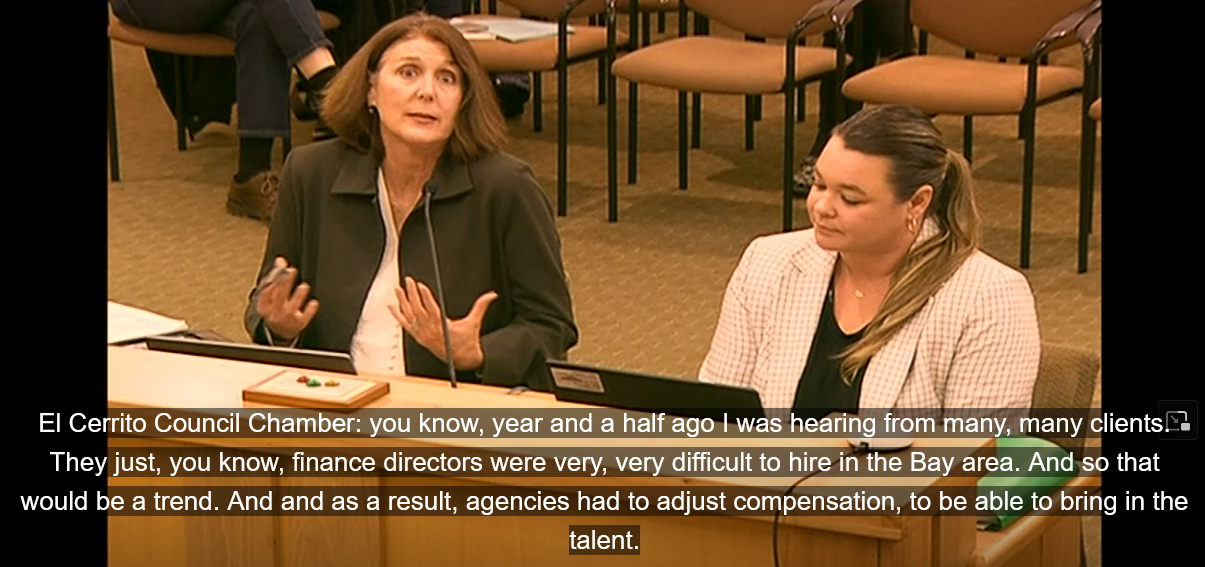
Is that the best way for us to be spending our money at this time? I don’t know for sure, but I do believe it’s a balancing act. You want pay to be competitive, AND you want the job itself to good, AND you have to consider whether it’s a strong labor market, whether there’s a risk of losing people. I don’t have any data on these topics; I’ve heard rumors that other cities would like to poach some of our staff, but of course that’s just hearsay. We don’t want to have a lot of vacancies in critical roles that leave us paying more total in overtime, and we especially DO want to retain highly competent people. Given what has happened with turnover and the apparent difficulty finding competent staff in the Finance Department, I would be really really cautious approaching the issue of salaries from a broad “gotta make cuts” mindset.
This study doesn’t directly address the key philosophical question of How much government is enough for El Cerrito?—although I believe that is in the works with an ongoing Service Delivery Study. Now, that study is running behind schedule, which is disappointing, but… TBH, I feel that. I get tired just thinking about the work they’re doing. My husband works in civic contracting and he has STORIES to tell about how tricky it is to work behind the scenes on this sort of thing. But I’m looking forward to seeing the results of that effort, since I think—like the completed Classification and Compensation study—it’s the kind of work that demonstrates the city is putting in a good-faith effort towards its current glow-up.
*One extremely important feature to be aware of in any staff/salary conversation is that most city staff are represented by a union, so entering into any kind of salary or benefits adjustment involves a complex (read: costly and time-consuming) negotiation. Unions have broadly seen something of a resurgence since the pandemic; I don’t know much about our local SEIU but I imagine they have a lot of bargaining power. I asked the manager of El Cerrito’s HR department (a tiny department of two, respect!) how many staff are represented by a union, and she said that pretty much only senior managers are non-union, and they have their own special non-union memorandum of understanding (MOU). So in the hypothetical world where we need to take severe action to balance the budget (again), any discussion of salary freezes or cuts (or layoffs) is complicated by how involved union negotiations can be.
**I did wonder how much this assertion holds true in relation to other top management roles. I looked through a snapshot of Police Chief salaries on Transparent California, and they vary WILDLY—I assume with some relation to size of city/department, or maybe other factors I’m not aware of. Then I wandered over to the State Controller’s Office website and my eyes popped at the top salaries in the state, mainly for Physicians and Investment Officers. Yikes. Anyway, in a crude attempt to get eyes on El Cerrito specifically, I pulled the top 1000 highest paid staffers from cities between 10,000-30,000 residents, and the one El Cerrito-relevant thing I saw was that our Fire Battalion Chiefs land right at the top of the list, and other Fire staff appear to be on the high end. Given that we staff three fire stations (including Kensington’s station), this might be something that deserves some conversation—but more likely, my extremely rough cut isn’t a good benchmark for comparable fire needs and services, since I barely recognized the names of the other cities in the list. This is why I would tend to trust the study experts: the “do your own research” impulse can lead one astray when you’re working outside of your own expertise. Regardless, I’m thinking I’ll write a post on fire safety in El Cerrito at some point since it seems like a big topic.