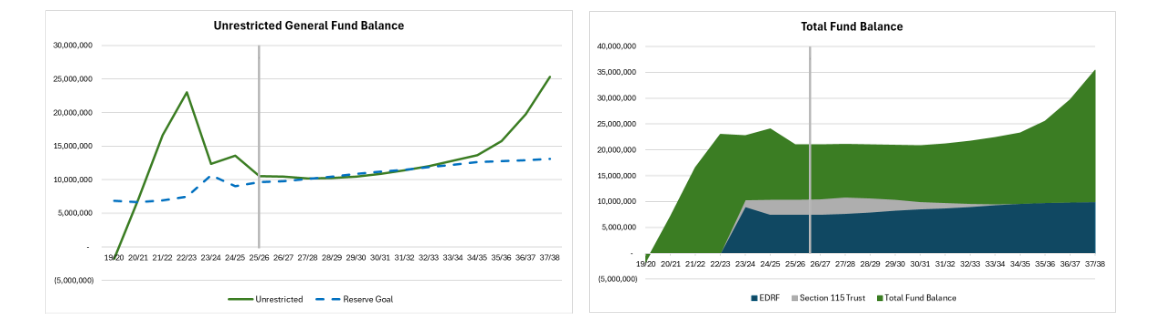
The financial situation of our city is one of the major hot topics in El Cerrito politics, so I figure it makes sense to start there. A lot of my initial impressions—particularly from reading the ECCRG blog—suggested a city in financial shambles, and indeed, there was undeniably a low point our recent history. But before untangling that history, I wanted to get acquainted with present day.
One of our city council candidates told me to take a look at the 2026 budgeting process, if I wanted to understand why she takes issue with the current government. I think she assumed I wouldn’t do it; otherwise (spoiler), I frankly wonder what she expected me to flag.
My approach was to watch city council meetings, starting from January 2026, any time there was an audit or budget update, presentation or “study session.” I familiarized myself with terminology and acronyms: CIP (Capital Improvement Program), ISF (Internal Service Fund), pension liability, section 115 trust. I started to get a handle on what the General Fund and all our other minor funds exist to pay for, and how our city Finance team approaches the budgeting process. I considered the structural forces behind the budget proposal: skyrocketing insurance costs, salary adjustments, how revenue projections are tied to the real estate market. I listened to the questions and comments of our council members; I read through the list of line-items (PDF) that the Finance team prepared with their recommendations for what the city could change, what could or should be cut in order to balance revenues and expenses, and what kind of trade-offs we were dealing with.
I was actually quite impressed, both by the Finance team staff, and the engagement of the city council and the public.
Let me start by saying, my prior expectations were low. Our city was in a severe crisis just a few years ago. It takes time to dig out of a hole. I figured we were probably still dealing with decisions made five, ten years ago—and we are. But I was pleased to see a few things:
- Our reserves today are healthy*. We currently have a 13% emergency fund (EDRF) that is fully funded, AND we currently have a bit over our target 17% unrestricted general fund reserve, AND about $3M set aside to smooth out the anticipated peak in our upcoming pension payments over the next decade (more on pensions later in its own post).
- We are, at long last, finding the means to set aside funds for future big capital expenses. Things like million-plus-dollar fire trucks, for example**. This is something we should have been doing all along, and will be a practice going forward that enables us to maintain a regular budget. The city’s approach is to set up an “Internal Service Fund” and since we’re just starting it this cycle, it won’t help for the big capital expenses we have to pay for right now, but it reflects a genuine maturity when it comes to thinking about responsible long-term budgeting practices.
- The council got an extensive menu of possible budget cuts to consider, from the relatively straightforward, to the increasingly painful and complicated, such as cutting traffic enforcement positions. (See May 5, 2026 City Council Meeting) They spent a great deal of time weighing the merits of different cuts and budgeting philosophies, and finally landed on a position that mostly prioritized maintaining reserves at the target levels—but not entirely.
- The Financial Advisory Board (FAB) offered a couple of recommendations, particularly the recommendation that the budget adopted not fall below a total reserve of 26% (meaning EDRF plus unrestricted reserves). The final adopted budget anticipates that total to be 30% in FY 2027 and 29% in FY 2028—with the unrestricted portion dipping to 16% in 2028—so the council significantly exceeded the FAB recommendation. Even on recommendations where the Council did not take any action, it seemed like they were listening to the FAB and attentive to their concerns.
- We have an improved resource for understand the planning status of future big projects, the Capital Improvement Program. Looking at it a bit, I’m still hoping to see it fleshed out more in the future so it’s even easier to understand what the city has in the works, but it’s a nice starting point, at least.
I appreciated the efforts of the staff to communicate what the city is dealing with in practical terms. They outlined how expenses are outpacing revenues, necessitating the above cuts, and which elements of those changes are under city control (like staffing levels and salaries) and which are due to, frankly, a dismal national and global economic scene. They talked about how they are evaluating the pension situation, and did their best to put what is an awfully esoteric issue into layman’s terms. I was very impressed with the finance team for their clarity of communication. I also learned that five out of six of them are new employees in the past 3 years—which makes their performance even more impressive, in contrast with the past finance team(s).
So in the end, the whole budgeting process exceeded my expectations, and I came away feeling largely satisfied that it was being carried out with both thoughtfulness and real expertise. Was it perfect? Of course not. But it gave me confidence that the folks steering the ship are taking their jobs seriously, and that we’re in a pretty strong position relative to just a couple years ago, and despite economic headwinds we’re pretty much staying the course.
*“Healthy” is subjective, of course. I’ve gotten into several arguments on Nextdoor about whether our reserves are adequate. I like this article for digging into some of the nuances around questions like “what are reserves for?”, “how big should reserves be?”, and “When, if ever, is deficit spending the right answer?” My take is that it’s a risk calculus, not necessarily that there is one right or wrong answer, and that today El Cerrito is doing a pretty decent job today of establishing and maintaining funds for rainy days and emergencies. Now, if we start seeing a continuing pattern of drawing down our unrestricted reserves year after year, we should certainly sound the alarm. But I suspect our leadership has learned a very painful lesson from careless spending back in the days of the State Audit, and won’t be likely to disregard a downward trend.
**A lot of the different opinions I’m hearing relating to whether the 2026 budget is responsible really revolve around this one big ticket item: We’re purchasing a $1.2M replacement fire truck because our current 15-year-old truck has reached the point where it risks becoming more expensive to maintain than replace. The city council approved the purchase in 2025 at the Fire Chief’s recommendation, partly in order to try to qualify for grant funding (I’m working now to follow up on what happened with that). The way the city finance team are framing the budget, this is a “one-time” expense, meaning it will be paid for in a large lump sum across the next two years, and then won’t be a factor in regular operating costs after that (assuming we are indeed setting aside enough in the ISF to pay for future trucks, of course). This means they are not factoring the cost of the truck into our reserves calculation which our Comprehensive Financial Policy states should aim to be 17% of General Fund operating expenses each year. Some may feel this is a bad (or even dishonest) framing; personally, it makes me want to reflect even more on the questions in the first footnote.
8/25/2026 CORRECTION: the original version of this post indicated that the fire truck replacement was “legally mandated.” I had mixed this up with the end-of-life requirement of another fire equipment purchase (SCBA, self-contained breathing apparatus). Many thanks to the sharp eyes of readers for catching this error.